
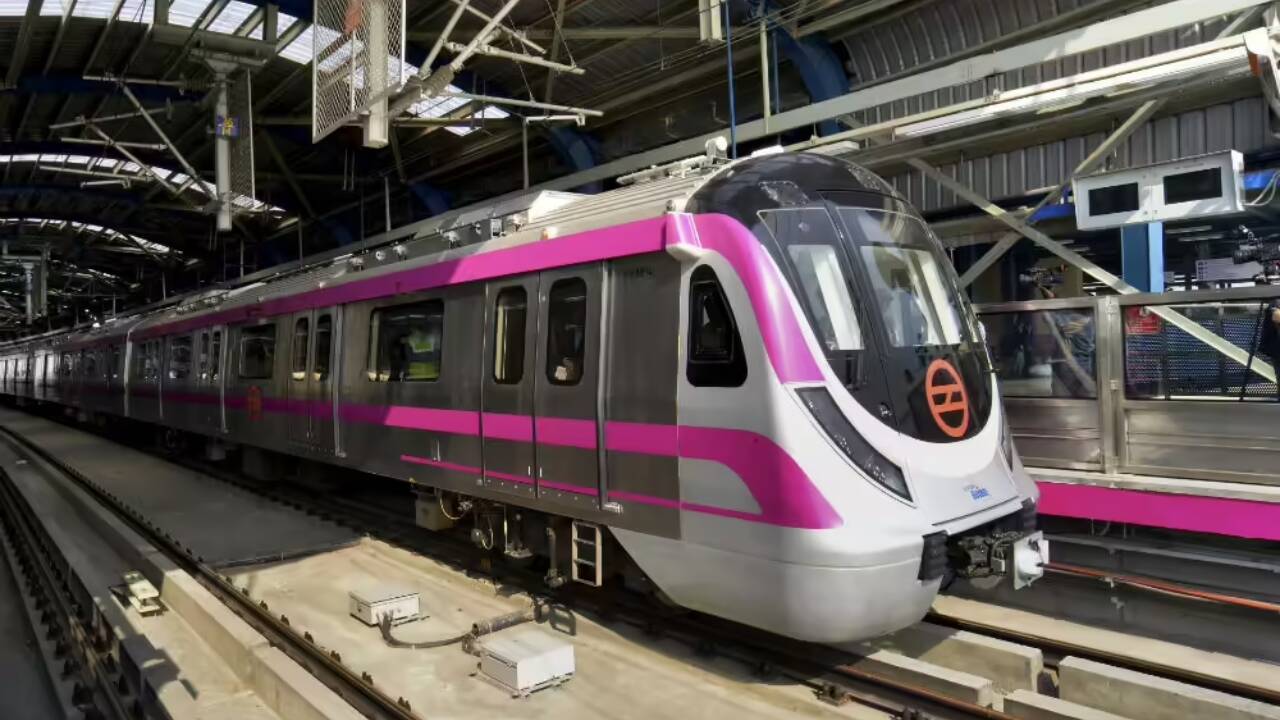
Delhi Metro driverless trains carry millions everyday; should other networks follow?
Times of India
Times of India
Delhi Metro currently operates 100 driverless trains over 120 km of its Magenta and Pink lines.
In 2020, Delhi Metro launched the first set of its driverless trains on the Magenta Line. Almost six years later, the driverless trains are an integral part of the Delhi Metro network as ridership grows in the country’s biggest metro network. Delhi Metro currently operates 100 Unattended Train Operation (UTO) trains over 120 km of its Magenta and Pink lines. This is 29% of the network, a share that is expected to grow as the driverless network expands to 198 km after ongoing projects are completed.
Delhi Metro got driverless trains in December 2020
Prime Minister Narendra Modi launched India’s first driverless train services on the Delhi Metro’s Magenta Line, which runs between Janakpuri West and Botanical Garden, on 28 December 2020. The driverless trains operate through a fully automated system, removing the possibility of human error. Following the introduction of driverless services on the Magenta Line, the Delhi Metro’s Pink Line adopted these trains as well.
1.6 million travel by driverless trains
Delhi Metro’s driverless trains carried a staggering 1.6 million passengers in a single day on November 2 this year, as commuters travelled in large numbers ahead of Diwali. This meant that one in every five of the network’s eight million daily passengers used a driverless train! The number is more than Arunachal Pradesh’s entire population, according to the 2011 Census, according to an ET analysis.
Driverless metro trains across India?
Vikas Kumar, managing director of Delhi Metro Rail Corporation (DMRC), believes the time has come for other metro rail projects to adopt this model. "Driverless train operations bring more flexibility to train operations, reducing human intervention and human errors. They also help improve the availability of coaches for service," Kumar told ET. He added that the reliability of Delhi’s driverless trains had improved manifold because of exhaustive self-tests carried out before the trains entered service, helping eliminate human errors. The technology, however, has its critics, including some within the government. They cite the higher initial capital expenditure required for driverless operations and the possibility that train drivers could become redundant. Sudhanshu Mani, the former railway general manager who played a key role in developing the Vande Bharat train prototype in 2018, has warned against India adopting driverless train technology without assessing its suitability for the country. While automation is increasingly becoming the global preference for new metro projects, he believes India should base its decisions on its own requirements rather than simply follow the international trend. "In India, with much lower staffing costs compared to the developed world, our own analysis instead of the global trend should dictate our decision," he told the financial daily. Mani acknowledged that driverless operations offer several operational benefits. "Automation eliminates human error, guarantees precise arrival and departure schedules, and frees up additional passenger space where the driver's cabin would normally sit," he said. However, a conclusive comparison of the costs and benefits of driverless and conventional metro systems is not readily available.
Responding to concerns that automation could eliminate the need for train drivers, DMRC managing director Vikas Kumar said none of the operators who stopped driving trains after driverless services were introduced in 2020 had lost their jobs. Instead, they were assigned other responsibilities within the organisation. DMRC currently employs around 3,000 train operators. Across India, metro rail services are running in 26 cities, including Delhi-NCR, Mumbai, Bengaluru, Kolkata, Hyderabad, Chennai, Lucknow, Pune and Ahmedabad. "They have been strategically deputed for tasks such as station management, crowd control etc.," he added.
AI Summary
Delhi Metro currently operates 100 driverless trains over 120 km of its Magenta and Pink lines, accounting for 29% of its network. The system carried 1.6 million passengers in a single day, sparking debate over automation costs versus operational benefits.
Sentiment analysis
AI insights
Financial analysis
Relevance
medium
Market sensitivity
medium
Affected sectors
Affected assets
Follow this story on TV
Live charts and AI commentary on one screen with Trade on tv.