Google AI agents audit Signal’s code and one major flaw stays hidden
CryptoSlate
CryptoSlate
Google DeepMind researchers say their AI agents produced mathematical proofs linking specific security guarantees to a compiled build of Signal’s encryption library, and they put the resulting evidence online for others to check.
The Nov. 10 AlphaProof Code report describes about 6.5 million lines of machine-checked Lean proof code. The result concerns a particular build of libsignal, the Signal protocol’s implementation, under explicit assumptions about cryptography and the environment in which the code runs.
The authors say five people worked on the proofs over four weeks. Humans directed the work, selected reference models and reviewed the specifications that defined what the agents had to prove.
What Google DeepMind's proofs cover
The target was an AArch64 Linux executable using libsignal-protocol v0.105.4 and SPQR v1.6.0 inside a small command-line harness. The theorems cover session initialization, sending a message, and receiving one. Key generation falls outside that verified scope.
The Google report connects the compiled executable to specified properties of PQXDH and Triple Ratchet one-to-one messaging, including forward secrecy, authentication, and post-compromise security.
These address whether earlier messages stay secret after keys are stolen, whether senders are authentic, and whether a session can regain secrecy after a compromise.
Its two proof models provide different assurances: the symbolic analysis relies on idealized cryptographic operations and collision-free executions, while the computational analysis bounds the success of classical attackers under stated cryptographic assumptions.
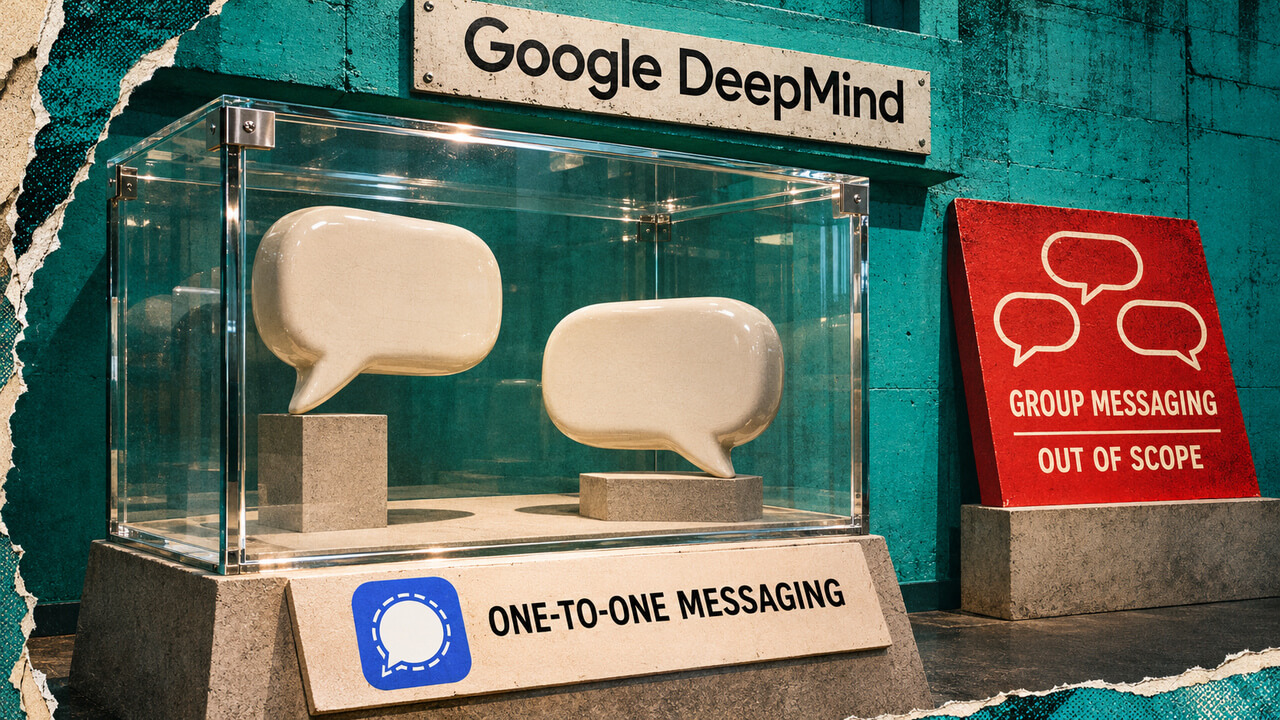
The symbolic proof establishes handshake secrecy under specified later breaks of Diffie-Hellman, but the computational proof does not cover quantum attackers. Group messaging is outside the report’s scope, and the computational model excludes multi-device state. Its bounds also stop providing a useful guarantee at sufficiently large workloads.
The results still require trust in Lean’s checking kernel, the specifications reviewed by the researchers, the AArch64 Linux model, and contracts describing selected routines.
The project’s Nov. 11 update, merged on GitHub, says ten more library routines were verified, cutting trusted routine hooks from 37 to 27. Those hooks replace execution of selected routines with assumed descriptions of their behavior.
The update retains libsignal v0.105.4 but changes the pinned executable. The newer build verifies the machine code for those ten routines instead of relying on their modeled contracts.
The project repository provides public instructions to rebuild the pinned binary and check its proofs. A Linux-only comparator checks that the theorems and their dependent definitions match trusted statements, then replays proofs in a fresh Lean kernel.
The authors also report reintroducing two previously fixed libsignal bugs and proving that the modified binaries violate their symbolic security theorem. That tests whether the specification rejects those known regressions.
The public package gives other researchers a concrete way to check the claimed connection between security requirements and executable code.
AI Summary
Google DeepMind researchers used AI agents to produce about 6.5 million lines of machine-checked Lean proof code linking security guarantees to a compiled build of Signal's libsignal encryption library, publishing the evidence online for public verification under explicit cryptographic and environmental assumptions.
Sentiment analysis
AI insights
low
6h ago
general
Financial analysis
Relevance
medium
Market sensitivity
medium
Affected sectors
Affected assets
Follow this story on TV
Live charts and AI commentary on one screen with Trade on tv.