
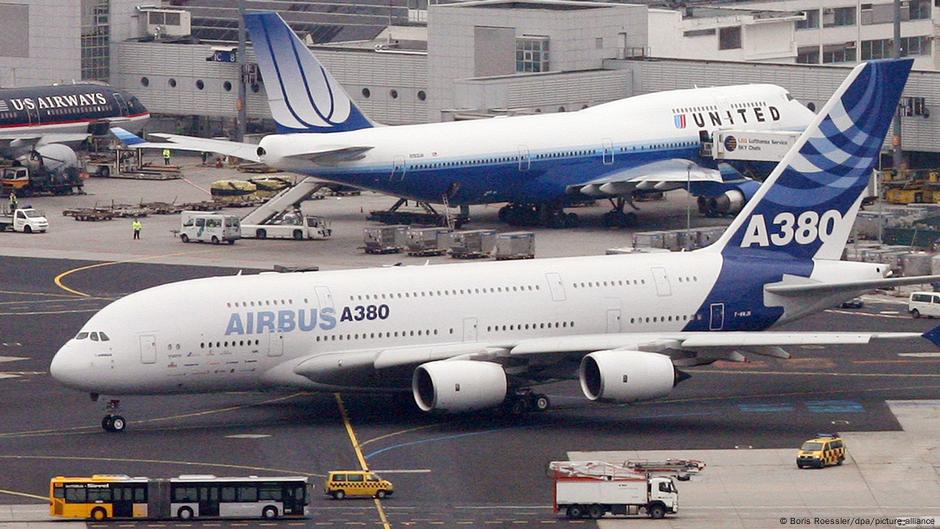
US challenges Airbus €3 billion EIB financing, raising fears of renewed transatlantic trade tensions
Deutsche Welle
Deutsche Welle
A fresh row over a record-breaking EU loan to European aerospace company Airbus could reopen a long-standing rift with Washington and threaten an existing EU-US trade truce.
The European Investment Bank (EIB), the lending arm of the EU, agreed in June to loan Airbus up to €3 billion ($3.4 billion) but US President Donald Trump's top trade advisor recently suggested the loan breached a 2021 EU-US agreement on state support.
"I had sincerely hoped that trade-distorting European subsidies to Airbus were a thing of the past," US Trade Representative Jamieson Grier said in late October. "For decades, France, Germany and Spain have aggressively supported Airbus, their national champion aircraft manufacturer, to gain an unfair advantage over US aerospace workers and business."
He also suggested there was a lack of transparency around the terms of the loan. The EU insists the loan does not amount to subsidies, that it is in close contact with the Office of the US Trade Representative and "will provide all necessary information," a spokesperson told DW.
An Airbus spokesperson told DW the company is "actively engaging with the relevant authorities and are happy to share more information about the loan with governments."
A thorn in the side of EU-US trade relations
Airbus and the US company Boeing, the world's two largest plane manufacturers, were previously involved in a 17-year corporate trade dispute.
The World Trade Organization (WTO) ruled that both the EU and US provided the companies with state subsidies, resulting in years of tariffs, tit-for-tat retaliation and claims of victory by both sides.
A deal to end tariffs with strict provisions on state support was finally agreed in 2021 and strengthened in 2025, but the latest row threatens to reopen the dispute and could potentially threaten the wider EU-US tariff deal agreed last year, experts say.
The previous Airbus-Boeing dispute was one of the longest-running corporate disputes in history and led to billions of dollars' worth of tariffs leveled by both sides.
"Trade experts tend to hate to talk about it because there are so many ups and downs to the story, it took so long to get resolved and it always tends to creep back up again," Inu Manak, a senior fellow at the Peterson Institute for International Economics who specializes in international trade law and policy, told DW.
She says because the issue is such a "persistent thorn in the side" it has the potential to spiral but for now the US is only signaling displeasure before things escalate. "They want to talk about this, and that conversation will need to happen before anything goes further," she said.
Does the €3 billion Airbus loan amount to state support?
At the heart of the current dispute is whether the €3 billion loan from the EIB, the largest corporate loan ever authorized by the bank, amounts to illegal state support.
"The EIB loan to Airbus is a standard loan on market terms," a European Commission spokesperson told DW. "It carries interest, it must be repaid in full, and it is the type of financing the EIB provides every year to companies across many sectors."
A spokesperson for the bank told DW the €3 billion loan is "a standard EIB corporate loan, implemented under the bank's established procedures and on market-based terms." It says it considers the financing to be "fully consistent with the market-terms principle" of the 2021 deal.
A spokesperson for Airbus told DW the loan is "a standard corporate financing facility, similar to commercially available loans we've signed in the past."
Fredrik Erixon, founding director of the European Centre for International Political Economy, says the lines are still blurred when it comes to what counts as a subsidy and what is just a loan and that only a comprehensive World Trade Organization investigation could establish the full facts.
Another potential issue is how the €3 billion will be used, including the share earmarked for research and development and how much funding will support defense-related activities versus commercial aircraft development.
Inu Manak says it is impossible at this point to determine if the loan amounts to the provision of illegal subsidies or not, and that it depends on the very specific terms of the credit provided and whether or not it could be proved to be damaging to Boeing's business.
"If it's a market-based loan, if it's not providing below-market rates that would provide an unfair advantage, then it should be fine," she said. "That remains to be seen."
In Erixon's view, the situation is further complicated by the fact that the aerospace sector is "a highly murky business" due to the amount of defense contracts companies like Boeing and Airbus hold with governments and the high costs associated with that in terms of research and development.
"The problem is we've ended up in a world where there's only two large aircraft manufacturers," he told DW. "And it is a business with high upfront costs when you're going to develop different things."
He points out that while Boeing may have a legitimate grievance over this loan, Airbus and the EU can point to Boeing's own deals with the US government.
"Boeing does R&D contracts for military purposes, which end up producing technology and support for the civil aircraft program for Boeing," said Erixon. "That's also what the World Trade Organization found previously."
It was Boeing that originally asked the US trade representative back in July to intervene over the loan, linking it to Airbus' plan to develop a new single-aisle aircraft program, which could spark a new era of intense competition between the two giants.
Why the Airbus-Boeing subsidy dispute keeps resurfacing
Inu Manak thinks the next obvious step for the US would be to launch a Section 301 investigation, which is an official inquiry to determine if the loan "violates an international trade agreement or is unjustified, unreasonable or discriminatory, and that burdens or restricts US commerce."
She thinks the Trump administration has no interest in engaging with the WTO and believes it has the potential to threaten the broader EU-US trade agreement.
"I don't think there's a lot that can stop the US trade representative from taking action if they decide they want to do it," Manak said. "They may think there may be something else to extract from the European Union."
Fredrik Erixon agrees that "it's going to be a point of leverage that the Americans can use against Europe," adding that the dynamics underpinning the aerospace sector — that both Boeing and Airbus need greater government investment due to ramped-up military spending — is the fundamental underlying problem.
"We are getting into a state aid race, which basically means these companies just need more and more and more money," he said. "That in itself is an escalatory development."
AI Summary
A €3 billion European Investment Bank loan to Airbus has triggered a dispute with the US, with officials alleging it violates state support agreements. The conflict threatens to revive a long-standing trade war between Airbus and Boeing.
Sentiment analysis
AI insights
low
1h ago
general
Financial analysis
Relevance
medium
Market sensitivity
medium
Affected sectors
Affected assets
Follow this story on TV
Live charts and AI commentary on one screen with Trade on tv.