
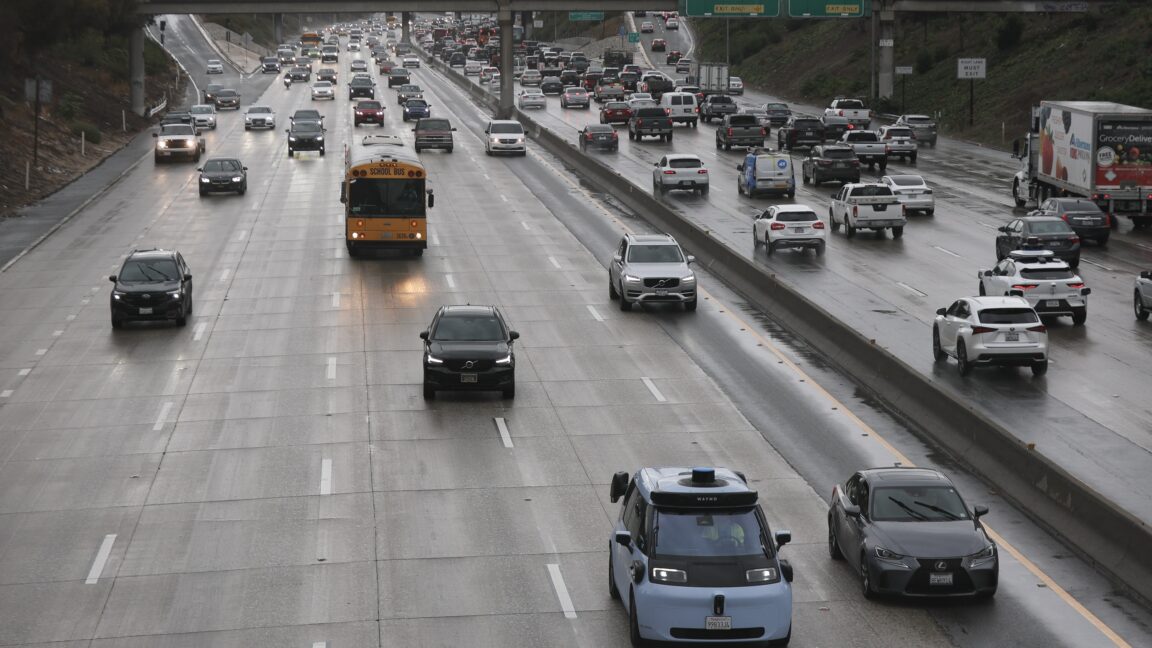
Waymo suspends freeway driving after California construction zone complaint
Ars Technica
Ars Technica
Waymo is currently restricting its fleet of robotaxis to surface streets after getting into hot water with California over its cars’ driving behavior on highways. Specifically, the software tends to drive into construction zones at speed. As first reported by the San Francisco Business Times, this behavior actually drew the ire of California’s DMV earlier this month, which ordered Waymo to stop driving on Californian highways immediately and until it can convince the DMV that its cars no longer “pose an imminent hazard to public safety.”
This is not Waymo’s first run-in with this problem. In Arizona, Waymo robotaxis did not recognize ramp closure signs on six occasions in Phoenix in April and entered construction zones. A month later in California, seven Waymo robotaxis entered lanes with active construction. In June, Waymo recalled the almost 3,800 robotaxis capable of highway driving. That problem led Waymo to stick to surface streets only in California after the May incidents until late July, when the robotaxis resumed highway operations.
In early July, Waymo told the National Highway Traffic Safety Administration that it began updating the robotaxi software to a version that “improve[s] the recognition of freeway construction zones, more appropriately prioritize[s] construction zones over other freeway hazards, and reduce[s] speed when the AV detects that it may be in a construction zone.”
Waymo also told the government that the updated software is better able to respond to emergency vehicles when in a construction zone and that the company has made “operational changes that better identify and mitigate potential entry into pre-planned construction zones and enable more Remote Assistance capability” if it happens again.
Which it has. Despite the update to improve behavior around emergency vehicles, a video went viral in early November showing a Waymo robotaxi on I-280 driving past a pair of California Highway Patrol cars conducting a rolling roadblock as they held traffic behind a slow-moving construction vehicle. California also says there was an incident in which a Waymo robotaxi entered a construction zone on US 101 near Burlingame.
“Safety is at the foundation of everything we do,” Waymo told Ars. “Following recent freeway construction zone encounters on U.S. 101 in California that did not involve any injuries or collisions, the California DMV has implemented an operating restriction on freeway operations in the state. In alignment with our safety-first principles, we have also temporarily restricted freeway operations across our other operating markets to evaluate our performance. Our ride-hailing service continues to operate safely on surface streets, serving over half a million trips each week. We are working with the California DMV and other state officials diligently and responsibly to resume freeway operations.”
Waymo also told Ars it was continuing to work with the various California agencies that regulate transport.
Until the suspension, Waymo was only conducting highway operations in Los Angeles and the Bay Area in California, as well as in Arizona.
AI Summary
Waymo has restricted its robotaxi fleet to surface streets after the California DMV ordered a halt to highway operations. The decision follows recurring incidents where autonomous vehicles entered active construction zones, posing safety risks to the public.
Sentiment analysis
AI insights
low
14m ago
general
Financial analysis
Relevance
medium
Market sensitivity
medium
Affected sectors
Affected assets
Follow this story on TV
Live charts and AI commentary on one screen with Trade on tv.